Have you experienced significant tooth loss in your lower or upper jaw, or even both jaws?
If a standard bridge wouldn’t be suitable or you’re unhappy with dentures, you might have discovered the possibility of a more permanent restoration with dental implants.
However, while implants can replace both the root and crown of a missing tooth, it’s only possible to place them if the jawbone is stable enough to anchor them.
Fortunately, if you don’t have enough bone for a dental implant, Dental Solutions can help!
No matter the reason for your loss of bone density, we can replace lost bone in your upper or lower jaw with a type of oral surgery called a bone graft.
A bone grafting procedure can supplement the existing bone to increase bone levels, which will create a stable base for dental implants once healed. A sinus lift may also be required if there is not enough bone height in the upper jaw.
Following successful bone graft surgery, we can help you get the full and functional smile you deserve with dental implants.
Schedule your bone graft consultation now to begin your journey towards a restored smile with personalised treatment at Dental Solutions!
Call Us
When is a bone graft necessary?
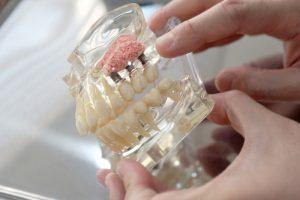
A dental implant consists of a screw that acts as a tooth root, an abutment on top of it for the cap to rest on, and a dental crown to function as the tooth above the gum line.
For the implant to be successful, it needs to be able to integrate with the jawbone – but this won’t be possible without sufficient bone density to support it.
There are lots of reasons why someone might lose bone density in their jaw, from dental trauma and injuries to tooth decay and infections, which can all cause tooth loss.
Using your teeth to bite and chew stimulates your jawbone through the roots – but when you have missing teeth, the lack of stimulation eventually causes the body to reabsorb the bone in the affected area, so you can use the minerals elsewhere.
Over time, this can leave you with reduced bone density wherever teeth have been lost. Not only can serious bone loss change the shape of your jaw and affect your appearance, but it can also impact your ability to eat and speak normally.
If this has happened to you, dental implants that can stimulate your jaw like real teeth (while also looking like natural teeth) could be the solution – but you may need to improve the volume of your jawbone with bone graft treatment first.
When you come to us, we will assess the condition of your jaws and advise you on whether a bone graft, a sinus lift, or an alternative like zygomatic implants would be most suitable.
Contact Us
How does a bone graft work?
A bone graft is a common surgery that can be used in various parts of the body, but a dental bone graft must be carried out by a trained dental specialist. Our oral and maxillofacial surgeon, Dr Richard Brookshaw, has years of experience in this field.
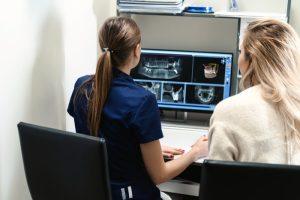
When you attend a consultation, you’ll not only need an oral examination, but also a CT scan, so we can determine whether you need a bone graft or not. While X-rays are 2D, CT scans produce 3D images that can reveal your bone volume.
This means we can provide an accurate diagnosis and develop a viable treatment plan that’s customised to your personal condition, medical history, and expectations.
The jaw bone graft procedure involves numbing the area with anaesthetic, cutting into the gum to access the bone, inserting the graft material, and stitching the gum closed.
Most commonly, this is a xenograft – placing purified bovine particulate at the graft site will provide a scaffold for your natural bone to grow around it and absorb the graft material.
This encourages bone regeneration in the targeted area over several months, restoring the jaw to the required density and developing a strong and stable base for future implants.
If you’ve only lost a small amount of bone, it may be possible to place dental implants on the same day as the bone graft operation, so they can heal and integrate at the same time. When treating significant bone loss, it’s likely you’ll need to wait 6–9 months in between.
Of course, this all depends on the condition of your individual jawbone and whether the aim is to insert implants or simply restore the bone. Based on the results of your examination and CT scan, we’ll map out a long-term plan for you.
Become a Member
Meet our oral surgeon: Dr Richard Brookshaw

Specialising in maxillofacial surgery and dental implants, Dr Richard Brookshaw is a highly skilled oral surgeon who works alongside the principal dentist, Dr Gavin Laidlaw.
Dr Brookshaw qualified as a dentist back in 1996, and since then, he has achieved multiple certifications in oral surgery, specialising in implant dentistry for patients with bone loss.
Not only does Dr Brookshaw have around 20 years of experience in successfully placing thousands of dental implants, but he also lectures internationally for Nobel Biocare.
Along with Dr Laidlaw and our team of friendly nurses and technicians, Dr Brookshaw helps patients at Dental Solutions to accomplish healthy bone levels and restore lost teeth.
When you come to us for a bone graft procedure, you can relax knowing you’re in extremely capable hands – so book your bone graft assessment today to begin the process!
New Patients
Set up a bone graft consultation
Over the years, the dependable Dental Solutions team has completed numerous bone graft treatments to help patients who don’t have enough bone for dental implants.
With accredited dental professionals operating to the highest standards, you can trust us to deliver brilliant results, transforming your dental health and quality of life.
When you come to our practice for an initial consultation, after examining your jaws and conducting a CT scan, we will develop a personalised treatment plan for you that offers the best option to reach the outcome you’re looking for.
If you’re a nervous dental patient, don’t worry – just tell our friendly staff and we can take extra effort to ensure that you’re totally comfortable every step of the way.
Learn more about the different types of dental implants in our blog, or reach out to arrange an appointment, during which one of our dentists can answer any questions you may have.
Call the dental office reception on 01925 756 565 or submit the enquiry form on this page and we’ll be in touch to set up your consultation for a bone graft in Warrington, Cheshire.
How to find us
Meet the Implant Team
Dr Richard Brookshaw
BDS | MMedSci (Oral Surgery) | MPhil (Oral and Maxillofacial Surgery) | DipImpDent RCS Ed
He first qualified in 1996 from the University of Dundee. Then in 1999, he gained his Masters's degree in Oral Surgery from the University of Sheffield, and further extended his clinical qualification in…
Dr Gavin Laidlaw
BDS (Manchester) 1987
Gavin, BDS Manchester 1987, is the principal partner in Dental Solutions. He has led the team at the practice in Lymm for over 25 years. Gavin has been a dental practice owner for…
This nice lady had a wonky smile line, and had lost two teeth as…
Learn More
This lady was very unhappy with her unsightly front teeth, which were loose and…
Learn More
This patient was very unhappy with the fact that he had a number of…
Learn More
FAQs
Is a bone graft painful?
Before bone graft surgery, the patient will receive a local anaesthetic to ensure the area is completely numb so they won’t feel pain.
Modern advancements mean it’s no longer necessary for bone to be taken from a different part of the body for a graft, so you won’t need to worry about a separate operation or pain in that area as well. Instead, we use a biocompatible substitute.
If you’re an extremely nervous dental patient, you can ask about conscious sedation, which induces a relaxed and sleepy state so you’re less focused on the procedure.
As with any surgery, in the days following a bone graft operation, patients are likely to experience some discomfort around the surgery site due to swelling and tenderness as it begins to heal. This can be managed with over-the-counter painkillers.
You’ll receive comprehensive aftercare guidance from your dentist before and after the surgery, but if you have any concerns, you can get in touch for further advice.
Where does the bone come from for a bone graft?
In the past, an autograft was the gold standard. This involves taking bone from the patient’s own body – such as the chin, skull, or hip – to use on the graft site.
While using the patient’s own bone often encourages faster healing due to the shared genetic code, it doesn’t always guarantee long-term stability. Sourcing the material from elsewhere in the body will also create a second surgical site and more discomfort.
To avoid these issues, bone grafts for dental implants typically use alternative graft materials like Bio-Oss, which is a sterile bovine-derived bone substitute.
It has a very similar structure to natural human bone, which can help to rectify bone defects and develop a stable base for dental implants with a long-term survival rate.
This makes both bone graft surgery and implant surgery much easier for the patient.
If you have more questions about the bone grafting process and materials, book a consultation at Dental Solutions and an expert can answer them for you.
How much does a bone graft cost?
We want to make dental implants as accessible as possible at Dental Solutions, so if you need a bone graft, too, we don’t want you to stress about the cost.
A price list of our private fees is available on our website so you know what to expect, and we can explain the costs for you as part of your consultation.
We can discuss all your options in detail – including payment options – to help you decide on the best treatment pathway for the factors you’re working with.
With a credit partner, we can offer dental finance to patients who need to spread the cost of treatment, which would allow you to get the bone graft you need without delay and then make monthly repayments.
For more information about our bone graft prices or payment plans, contact us and schedule a consultation at Dental Solutions.
Back to Dental Implants


